The icosahedral family
7 Nov 2026
Of the 48 regular polyhedra described in my previous article, 12 have symmetry groups that contain a 5-fold rotational symmetry. These are all finite and can collectively be called the “icosahedral family”. The diagram below, which is based on a diagram I drew shortly before writing my previous article (but which was not included in that article for the sake of brevity), shows the relationships between the polyhedra of the icosahedral family.
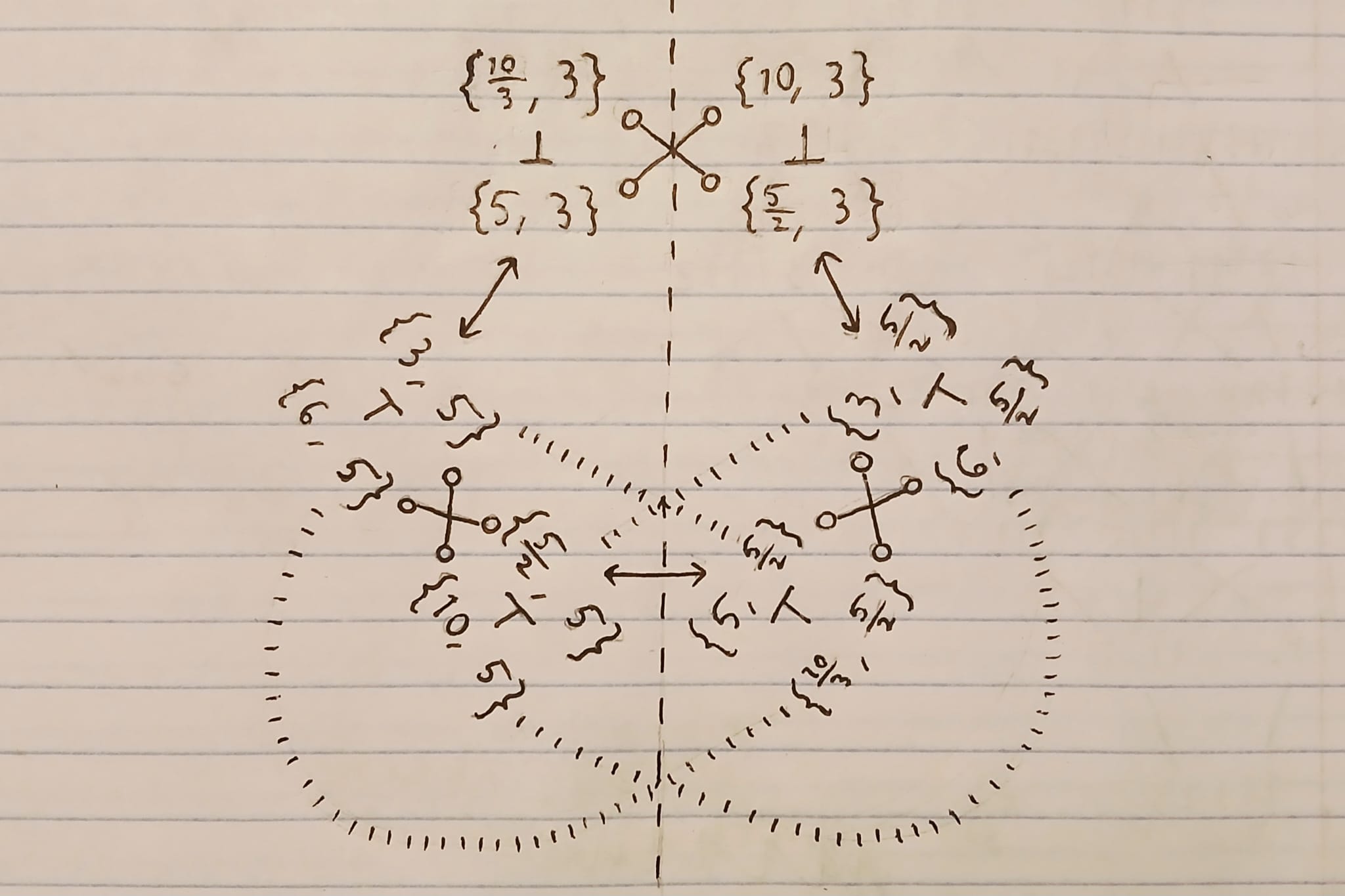
Notes:
- \(\{p,q\}\) is a Schläfli symbol; it denotes a polyhedron with faces of type \(\{p\}\) and vertex figures of type \(\{q\}\).
- The 6 polyhedra in the inner circle have planar faces, while the outer 6 polyhedra have skew faces. The former group consists of the icosahedron \(\{3,5\}\), the dodecahedron \(\{5,3\}\), and the four Kepler-Poinsot star polyhedra.
- Double-headed arrows denote duals. This operation replaces \(\{p,q\}\) with \(\{q,p\}\).
- Lines with circles at the ends denote petrials. This operation preserves the vertex figure but changes the face.
- Tack symbols denote the operation of replacing the vertex-swapping generating mirror (which I denoted \(C_0\) in the last article) with its orthogonal complement. This also preserves the vertex figure but changes the face. Specifically, the two face types \(\{p\}\), \(\{p'\}\) are related by \(\frac{1}{p} + \frac{1}{p'} = \frac{1}{2}\). Thus 3 is exchanged with 6, 5 with 10/3, and 5/2 with 10.
- Dotted lines denone “facetting”. This is an operation that takes a polyhedron and returns a new polyhedron with the same vertices and edges, but with faces that take the second left turn at each vertex instead of the first left turn. All of the facetting relationships within the icosahedral family are bidirectional, which is not the case for general polyhedra. The four polyhedra on the top with vertex figure 3 are related to themselves by facetting.
- Each polyhedron is “abstractly equal” to its reflection across the dashed line down the middle. What I mean by this is that the two polyhedra have the same vertex-edge-face incidence relations but are embedded differently in Euclidean space. This duality swaps 5 with 5/2 and 10/3 with 10, in both the face and the vertex figure.